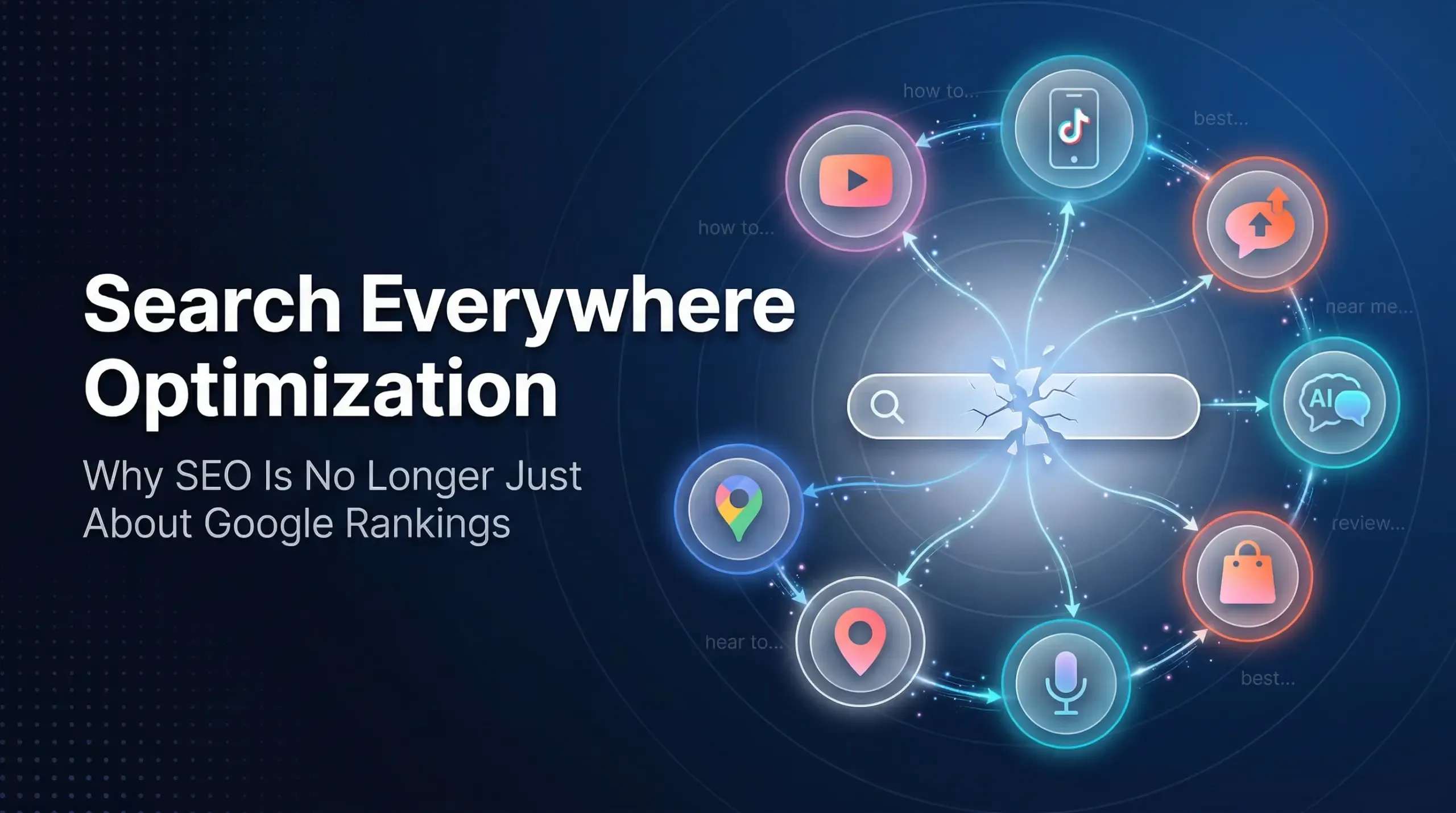
Search Everywhere Optimization: Why SEO Is No Longer Just About Google Rankings
SEO has evolved beyond Google. Learn how search everywhere optimization builds visibility across YouTube, TikTok, Reddit, AI tools, and every platform your
SEO Is No Longer Just About Google Rankings
SEO has evolved far beyond chasing the number one spot on Google. If your entire strategy still revolves around ranking in the traditional ten blue links, you are playing a game that changed years ago. Today, people search on YouTube, TikTok, Reddit, Amazon, ChatGPT, Perplexity, and even Instagram before they ever touch Google. Modern search everywhere optimization demands visibility across every platform where your audience looks for answers.
Google’s own Search Liaison, Danny Sullivan, said it best: “One of the ways to be successful with Google Search is to think beyond it.” When Google itself tells you to look elsewhere, it is time to listen.
How Search Behavior Has Changed (And Why SEO Must Follow)
Consumer search journeys now span six or more touchpoints before a purchase decision. According to SparkToro and Datos research, users regularly engage with seven or more platforms and spend over four hours daily across different search surfaces. Google still commands roughly 90% of traditional search engine market share, but that statistic hides a critical truth.
Nearly 40% of Gen Z users search TikTok or Instagram before Google when looking for restaurants, products, or recommendations. YouTube processes over 3 billion searches per month, making it the second largest search engine in the world. Reddit threads now appear in Google’s own AI Overviews, and AI assistants like ChatGPT and Perplexity are creating entirely new discovery channels.
Your audience no longer follows a single-platform search path. Your SEO strategy should not either.
What Is Search Everywhere Optimization?
Search everywhere optimization is the practice of building visibility across every platform where your audience searches and researches, not just Google. Semrush formally defined the concept in 2026, but practitioners like Ashley Liddell of Deviation trademarked the term “Search Everywhere” back in 2023.
Here is how it compares to traditional SEO:
- Traditional SEO: Focuses on Google rankings, backlinks, keyword density, and on-page optimization for a single search engine.
- Search Everywhere Optimization: Expands visibility to YouTube, TikTok, Reddit, Amazon, Pinterest, AI chatbots, voice assistants, and social platforms using intent-driven content adapted to each surface.
The core principles of SEO, such as understanding search intent, creating valuable content, and building authority, remain unchanged. The difference is where and how you apply them.
7 Search Surfaces You Must Optimize For in 2026
A strong multi-platform SEO strategy requires understanding how each platform works. Here is your platform-by-platform playbook:
1. Google (Still the Foundation)
Google remains essential, but the experience has transformed. AI Overviews now pull passages from content regardless of ranking position. Zero-click searches dominate quick-answer queries. Focus on featured snippets, People Also Ask boxes, and passage-level optimization to maintain visibility.
2. YouTube (The Second Largest Search Engine)
YouTube SEO requires keyword-optimized titles, detailed descriptions, chapters with timestamps, and engagement signals like watch time. Video content now appears directly in Google search results, giving you dual visibility from a single asset.
3. TikTok and Instagram (Social Search Revolution)
TikTok SEO relies on keyword-rich captions, on-screen text, and hashtags aligned with search queries. Instagram search favors alt text, caption keywords, and carousel posts. Both platforms reward content that answers specific questions.
4. Reddit and Forums (The Trust Layer)
Reddit threads increasingly surface in Google AI Overviews and traditional results. Authentic participation in relevant subreddits builds unlinked brand mentions that influence both Google rankings and AI citations.
5. Amazon and Marketplace Search
For e-commerce brands, Amazon SEO involves optimizing product titles, bullet points, backend keywords, and A+ content. Amazon processes hundreds of millions of product searches monthly, often bypassing Google entirely.
6. AI Assistants: ChatGPT, Perplexity, and Gemini
AI search optimization, sometimes called generative engine optimization, focuses on structured content that AI systems can easily parse and cite. Clear headings, factual claims with sources, and strong E-E-A-T signals increase your chances of being referenced in AI-generated answers.
7. Voice Search and Smart Assistants
Voice search queries tend to be conversational and question-based. Optimizing for natural language phrases and providing direct, concise answers improves your chances of being the selected voice result.
How to Build a Search Everywhere SEO Strategy (Step by Step)
- Audit your current visibility. Search your brand name and target keywords on Google, YouTube, TikTok, Reddit, ChatGPT, and Amazon. Document where you appear and where you are invisible.
- Map your audience’s search journey. Interview five to ten recent customers and ask them: “Walk me through how you found us and researched before purchasing.” Their answers reveal your true platform map.
- Create intent pillars, not just keywords. Go beyond individual keywords. Identify the full conversation behind each topic and map where that conversation happens across platforms.
- Repurpose content using the waterfall method. Turn one blog post into a YouTube video, TikTok series, Reddit discussion starter, LinkedIn article, email newsletter, and AI-optimized FAQ page.
- Build branded search as your north star metric. When people search your brand name alongside target keywords, Google associates your brand with that topic. Use social media, influencer partnerships, and PR to drive branded queries.
Why E-E-A-T and Brand Authority Matter More Than Ever for SEO
Google’s E-E-A-T framework (Experience, Expertise, Authoritativeness, Trustworthiness) has become the strongest ranking signal in 2026 according to multiple industry experts, including Marketer Milk’s analysis of the June 2025 Core Update. But E-E-A-T now extends beyond Google.
AI systems like ChatGPT and Perplexity evaluate brand trust by analyzing mentions across the web. If your brand is consistently referenced on Reddit, cited in YouTube descriptions, and mentioned in industry publications, AI tools are more likely to surface your content in their responses.
A powerful example comes from Rise at Seven, the SEO agency that helped lamp retailer Pooky rank number one for “rechargeable lights.” Their strategy was not traditional link building. Instead, they created UGC social media content that drove thousands of people to search “Pooky rechargeable lights” on Google. The branded search volume taught Google to associate Pooky with the keyword, lifting their organic ranking to the top spot.
This is the future of SEO: cross-platform brand authority driving search engine visibility.
Measuring SEO Success Beyond Rankings and Clicks
When SEO extends across platforms, your measurement framework must expand too. Traditional KPIs like keyword rankings and organic clicks still matter, but they tell only part of the story. Consider tracking these new metrics:
- Brand mention volume across social platforms, forums, and news sites
- AI citation frequency in ChatGPT, Perplexity, and Google AI Overviews
- Cross-platform share of voice compared to competitors
- Branded search volume growth in Google Search Console
- Referral traffic diversity from YouTube, Reddit, TikTok, and other surfaces
Tools like Semrush’s Traffic and Market Toolkit, SparkToro for audience intelligence, and manual AI search audits help you track visibility across the entire search ecosystem.
Frequently Asked Questions
Is SEO dead in 2026?
No. SEO is not dead; it has evolved. The core principles of understanding search intent, creating high-quality content, and building authority remain essential. What changed is the number of platforms where these principles apply. SEO now includes YouTube, TikTok, Reddit, AI chatbots, and more.
Does SEO only apply to Google?
Not anymore. While Google still processes the majority of traditional web searches, billions of searches happen daily on YouTube, Amazon, TikTok, Pinterest, and AI tools like ChatGPT. Effective SEO in 2026 means optimizing for every platform your audience uses.
What is Search Everywhere Optimization?
Search everywhere optimization is the strategy of building visibility across all platforms where your audience searches. It goes beyond Google to include social media search, video platforms, e-commerce marketplaces, forums, and AI-powered assistants.
How do I optimize for AI search engines like ChatGPT?
Focus on clear content structure with logical headings, factual accuracy with cited sources, and strong brand authority signals. AI models tend to pull from content that is well-organized, frequently referenced across the web, and demonstrates genuine expertise on the topic.
Is it worth optimizing for TikTok and Instagram search?
Yes, especially if your audience includes Gen Z or millennial consumers. That nearly 40% of younger users prefer searching TikTok or Instagram over Google for product recommendations, local businesses, and how-to content.
What percentage of searches happen outside Google?
While exact figures vary by industry, research from SparkToro and Datos shows that users engage with seven or more platforms during their research process. When you include YouTube, Amazon, social platforms, and AI tools, a significant and growing portion of total search activity occurs outside of Google’s traditional results pages.
The Future of SEO Starts Now
The brands that win in 2026 and beyond are not the ones obsessing over a single Google ranking. They are the ones showing up everywhere their audience searches, building genuine authority across platforms, and creating content that AI systems trust enough to cite.
Start today. Audit your visibility across all seven search surfaces. Interview your customers about their real search journeys. Build intent pillars that span platforms. And measure success by your total search presence, not just your position on one results page.
SEO is bigger than Google now. The question is whether your strategy has caught up. Take the first step by mapping your multi-platform visibility this week, and start building the search everywhere presence your brand deserves.
Subscribe for Legal Marketing Insights
Stay ahead with proven strategies, case studies and AI-driven tactics.