The Complete Law Firm SEO Audit: A Section-by-Section Diagnostic Guide
Walk through the complete law firm SEO audit process, from technical foundations and local search optimization to content gaps and backlink analysis. A

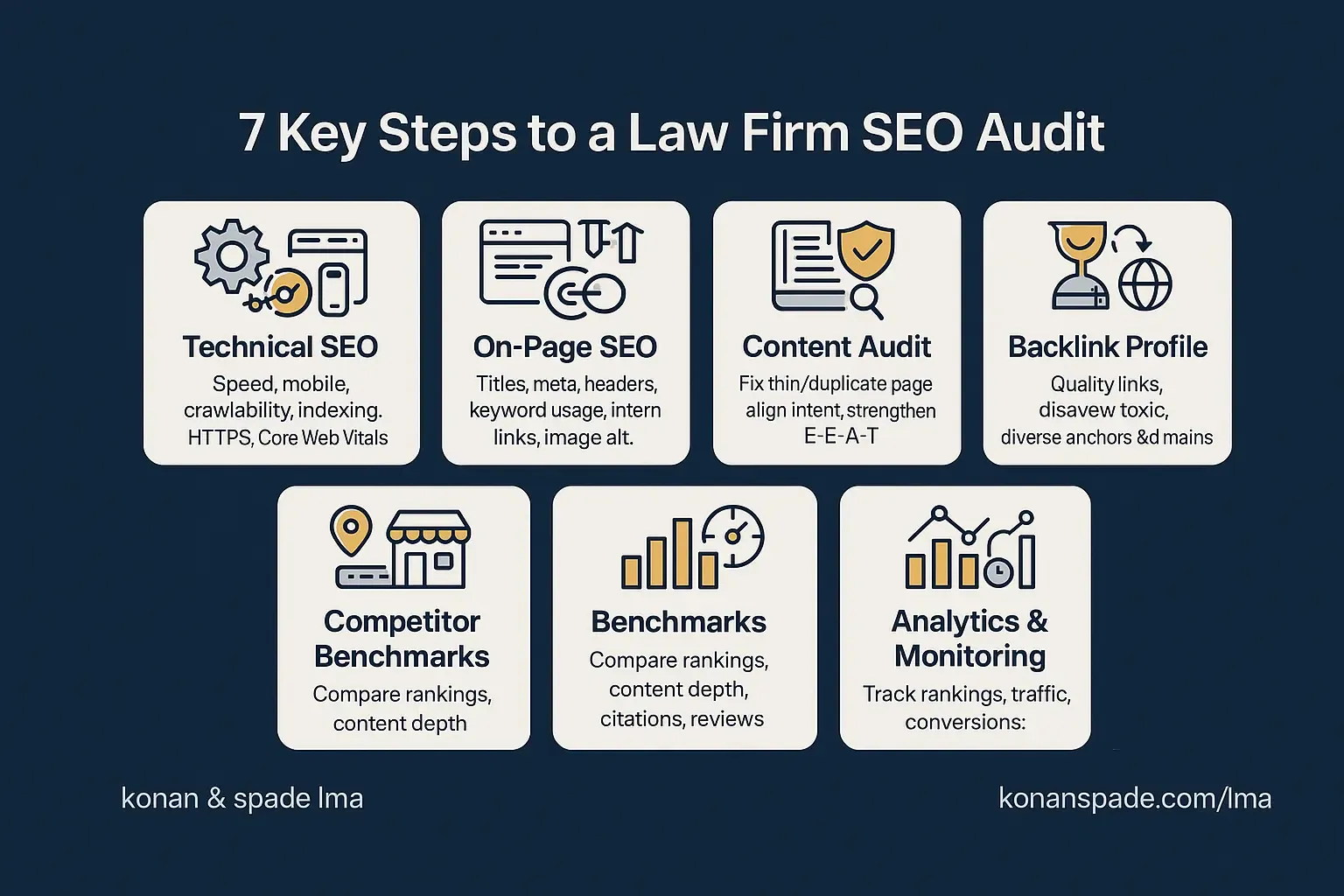
Most law firm websites have SEO problems they don’t know about. Not because the firms are negligent, but because search engines change what they reward, and yesterday’s best practices quietly become today’s ranking anchors. A proper SEO audit surfaces those hidden issues before they cost you cases.
This isn’t a surface-level checklist. We’re going to walk through the actual diagnostic process, section by section, that separates firms ranking in the local pack from firms buried on page three. Some of this is technical. Some of it is strategic. All of it matters if your firm depends on organic search to generate consultations.
Why Law Firms Need a Different Kind of SEO Audit
A generic SEO audit template won’t cut it for legal practices. Law firms operate in one of the most competitive search verticals that exists, competing for keywords where a single client could be worth tens of thousands of dollars. The stakes are different, so the audit has to be different.
According to SEOmator, organic search generates 53% of law firm website visitors, and SEO leads convert at 14.6%. Those numbers dwarf most other acquisition channels. But they only hold if your site is technically sound, locally optimized, and producing content that Google considers trustworthy enough to rank for legal queries.
Legal searches also carry unique E-E-A-T pressure. Google classifies legal content as “Your Money or Your Life” (YMYL), meaning it applies stricter quality standards. A plumber’s website can get away with thin service pages. A law firm’s cannot. Every page on your site is evaluated for relevance, expertise and trustworthiness.
There’s also the local dimension. Most law firms serve specific geographic areas, which means local SEO signals carry outsized weight. According to SEOmator’s analysis, law firms appearing in local packs capture about 44% of user clicks, and 75% of users only engage with the top three results. If you’re not in that top three, you’re effectively invisible for local searches.
Technical SEO: The Foundation That Makes Everything Else Possible
Technical SEO is where most audits should start, because nothing else matters if search engines can’t properly crawl, index, and render your pages. You can have the best practice area content in your market, but if Googlebot hits a wall of crawl errors, that content might as well not exist.
Crawlability and Indexing
Open Google Search Console. That’s step one. Look at the “Pages” report (formerly “Coverage”) and check for pages that are crawled but not indexed, pages blocked by robots.txt, and pages with noindex tags you didn’t intentionally set. Law firm websites frequently have orphaned pages, old attorney bios for lawyers who left the firm years ago, or duplicate practice area pages created during a redesign that never got cleaned up.
Your XML sitemap should list every page you actually want indexed, and nothing else. Submit it to both Google Search Console and Bing Webmaster Tools. Check robots.txt to make sure you’re not accidentally blocking important directories. We’ve seen law firm sites where the /attorneys/ directory was blocked by a leftover robots.txt rule from a staging environment. Every attorney bio page was invisible to Google for months.
Site Speed and Core Web Vitals
Speed matters more for law firms than most practices realize. According to research cited by SEOmator, 69% of visitors abandon a law firm website that loads slowly. Someone searching for a criminal defense attorney at 2 AM after an arrest is not going to wait five seconds for your homepage to render.
The specific metrics to measure:
- Largest Contentful Paint (LCP): Target under 2.5 seconds. This measures when the main content of your page becomes visible. Hero images and unoptimized header graphics are the most common culprits for poor LCP on law firm sites.
- Interaction to Next Paint (INP): This replaced First Input Delay in March 2024. It measures responsiveness when users interact with your page. Target under 200 milliseconds.
- Cumulative Layout Shift (CLS): Target under 0.1. This measures visual stability. If your page elements jump around as they load, chat widgets and cookie consent banners being common offenders, your CLS score suffers.
Run your key pages through Google PageSpeed Insights and test both mobile and desktop separately. Pay special attention to mobile scores; that’s where most of your potential clients are searching.
Mobile Responsiveness
Google uses mobile-first indexing, meaning it primarily looks at the mobile version of your site for ranking purposes. According to data from Clio cited by SEOmator, 23% of potential clients use mobile devices exclusively to find an attorney. Not as a supplement to desktop. Exclusively.
Test your site on actual devices, not just Chrome’s responsive mode. Check that:
- Phone numbers are tap-to-call on every page
- Contact forms are usable on a small screen without horizontal scrolling
- Navigation menus don’t overlap or hide critical content
- Text is readable without zooming
- Pop-ups and interstitials don’t block the entire mobile viewport
That last point deserves emphasis. Google has penalized intrusive interstitials on mobile since 2017, yet we still see law firm sites with full-screen pop-ups that fire the moment a mobile user lands on the page. If your live chat widget covers 80% of the mobile screen, that’s a problem.
HTTPS and Security
This should be non-negotiable in 2025, but it’s still worth verifying. Every page on your site should load over HTTPS with a valid SSL certificate. Check for mixed content warnings, which happen when a secure page loads some resources (images, scripts, stylesheets) over insecure HTTP. Mixed content can trigger browser warnings that destroy client trust instantly.
URL Structure
Clean, descriptive URLs help both search engines and users. Your personal injury page should live at something like /personal-injury-lawyer-chicago, not /page?id=847 or /services/practice-areas/sub-category/personal-injury-landing-page-v2.
Check for these common URL problems on law firm sites:
- Duplicate content from trailing slashes (both /about/ and /about serving the same page)
- Parameter-based URLs from old CMS configurations
- Overly deep URL paths with more than three directory levels
- URLs with session IDs or tracking parameters that create infinite crawl paths
On-Page SEO: Making Each Page Count
On-page optimization is where your content meets search engine expectations. Every important page on your law firm site, every practice area page, every attorney bio, every location page, needs to be individually evaluated.
Title Tags and Meta Descriptions
Title tags remain one of the strongest on-page ranking signals. For law firms, the formula that tends to perform well is: primary keyword + location + firm name, kept under 60 characters so Google doesn’t truncate it.
Examples of effective title tags:
- “Personal Injury Lawyer in Dallas | Smith & Associates”
- “Houston Divorce Attorney | Free Consultation | Jones Law”
Meta descriptions don’t directly affect rankings, but they affect click-through rate, which indirectly affects everything. Write them as a pitch to the searcher, not a summary for Google. Include a specific call to action. “Call for a free case review” outperforms “Learn more about our services” every time.
Header Structure
Use one H1 per page (your page title), H2s for major sections, and H3s for subsections. This sounds basic, but we regularly audit law firm sites where the H1 is the firm’s logo (pulled from the site header template), every practice area page shares the same H1, or headers are used for visual styling rather than content hierarchy.
Headers aren’t decoration. They tell Google what a page is about and how the information is organized. Get them right.
Content Depth on Practice Area Pages
This is where most law firms fall short. According to research cited by SEOmator from On The Map, 76% of people leave a law firm website if it doesn’t provide enough information about the firm. Thin practice area pages, the ones with 200 words of generic text and a contact form, don’t rank and don’t convert.
A strong practice area page should answer the questions a potential client actually has. For a personal injury page, that means explaining the types of cases you handle, the process of filing a claim, what damages are recoverable, the statute of limitations in your state, and what makes your firm different. Not in 200 words. In however many words it takes to genuinely help someone understand their situation.
Google’s E-E-A-T framework rewards content that demonstrates real experience and expertise. Attorney-authored content that references specific case types, relevant statutes, or jurisdictional nuances signals expertise far more effectively than generic descriptions that could apply to any firm in any state.
Internal Linking
Internal links distribute authority across your site and help Google understand the relationship between your pages. For a law firm, this means linking related practice areas to each other (your car accident page should link to your personal injury overview), linking blog posts to relevant practice area pages, and ensuring every important page is reachable within two to three clicks from the homepage.
During your audit, look for:
- Orphan pages with zero internal links pointing to them
- Practice area pages that only link to the contact page but not to related services
- Blog posts that never link back to commercial pages
- Broken internal links pointing to deleted or redirected pages
Local SEO: Where Most Law Firm Leads Actually Come From
For the majority of law firms, local search drives more qualified leads than any other channel. When someone searches “divorce lawyer near me” or “DUI attorney [city name],” they’re usually ready to hire. Your local SEO determines whether your firm appears in those results.
Google Business Profile Optimization
Your Google Business Profile (GBP) is arguably the single most important asset in your local SEO strategy. A fully optimized profile increases your chances of appearing in the local pack, which is the map-based result set that appears above organic listings for local queries.
During your audit, verify:
- Business name: Matches your actual firm name exactly. Don’t stuff keywords into it (“Smith Law | Best Personal Injury Lawyer Dallas”). Google penalizes this.
- Primary category: Use the most specific category available. “Personal Injury Attorney” is better than “Lawyer” if that’s your primary practice.
- Additional categories: Add all relevant practice area categories. You can have up to 10.
- Business description: Use all 750 characters. Describe your practice areas, your geographic service area, and what makes your firm distinct.
- Photos: Add real photos of your office, your attorneys, and your team. Profiles with photos receive significantly more engagement than those without.
- Regular posts: Google Business Profile posts signal activity and freshness. Post case results (anonymized), legal tips, firm news, or community involvement at least weekly.
NAP Consistency
NAP stands for Name, Address, Phone number. These three data points need to match exactly across every place your firm is listed online. Not “mostly match.” Exactly match. “123 Main Street, Suite 200” and “123 Main St., Ste. 200” are different in Google’s eyes, and inconsistencies erode your local ranking signals.
Check your NAP consistency across:
- Your website (header, footer, contact page)
- Google Business Profile
- Legal directories: Avvo, Justia, FindLaw, Martindale-Hubbell
- General directories: Yelp, BBB, Yellow Pages
- Social media profiles
- State bar association listings
If your firm has moved offices or changed phone numbers in the past few years, there are almost certainly outdated listings floating around the web. Finding and correcting them is tedious but essential work.
Reviews and Reputation Management
According to data cited by SEOmator from Andava, 80% of potential clients research attorney reviews online, and 47% won’t consider a firm with less than a 4-star rating. Reviews influence both your local pack rankings and your conversion rate.
Your audit should evaluate:
- Your overall star rating on Google
- The volume and recency of reviews (a firm with 12 reviews from 2021 looks stale)
- Whether you’re responding to reviews, both positive and negative
- Your ratings on legal-specific platforms like Avvo
A review generation process should be part of your firm’s standard client offboarding. Send a follow-up email after case resolution with a direct link to your Google review page. Make it easy. Most satisfied clients will leave a review if you ask; most firms never ask.
Local Citations and Directory Listings
Beyond NAP consistency, your firm should maintain active listings on legal-specific directories that carry authority in Google’s eyes. The essential ones:
- Avvo
- Justia
- FindLaw
- Martindale-Hubbell
- Super Lawyers
- Lawyers.com
- Your state and local bar association directory
Each of these profiles should be fully completed with practice areas, attorney bios, and contact information that matches your website exactly.
Content Audit: Evaluating What You’ve Published
A content audit goes beyond on-page SEO elements. It evaluates whether the content your firm has published is actually serving its purpose: attracting qualified organic traffic and converting visitors into consultations.
Identifying Underperforming Content
Pull up Google Search Console and Google Analytics. For every blog post and practice area page on your site, you want to know:
- How much organic traffic it receives monthly
- What keywords it ranks for (and at what positions)
- Its click-through rate from search results
- Engagement metrics: time on page, bounce rate, scroll depth
- Whether it generates any conversions (form fills, phone calls)
Sort your pages by organic traffic. You’ll likely find that 10 to 20% of your pages drive the vast majority of your traffic, while a long tail of pages get little to no organic visits. Those underperforming pages fall into a few categories:
Pages worth updating: They rank on page two or in positions 8 to 15. They’re close to driving real traffic but need better content, improved targeting, or stronger internal links to break through.
Pages worth consolidating: You have three separate blog posts about “child custody in Texas” that each rank poorly. Merge them into one definitive resource.
Pages worth removing: Outdated news posts, event announcements from 2019, or thin pages that add nothing. Either improve them substantially, redirect them to a relevant page, or remove them entirely.
E-E-A-T Signals in Legal Content
Google’s quality raters specifically look for Experience, Expertise, Authoritativeness, and Trustworthiness in YMYL content, and legal content is squarely in YMYL territory. During your content audit, evaluate whether your pages demonstrate these signals.
Practical ways to strengthen E-E-A-T on a law firm site:
- Attribute content to named attorneys with real credentials, not “Admin” or “Staff”
- Include author bios that list bar admissions, years of experience, and notable case results
- Reference specific statutes, case law, or jurisdictional rules rather than making generic legal statements
- Update content regularly, especially pages that reference laws or procedures that change
- Add structured data (attorney schema, legal service schema) to help Google understand author credentials
A blog post about “What to Do After a Car Accident in Florida” written by a named personal injury attorney with 15 years of Florida practice experience carries more weight, both with Google and with potential clients, than the same post published under a generic firm byline with no author credentials.
Content Gaps
Look at what your competitors rank for that you don’t cover at all. Tools like Ahrefs’ Content Gap analysis or SEMrush’s Keyword Gap tool can identify these opportunities systematically, but you can also do it manually by searching your primary keywords and examining what the top-ranking competitors publish that you haven’t addressed.
Common content gaps on law firm websites include:
- FAQ pages for specific practice areas
- Location-specific landing pages for cities or counties you serve
- Informational content addressing the questions people ask before they’re ready to hire (e.g., “How long does a divorce take in [state]?”)
- Case result pages or case study summaries
- Guides that walk potential clients through legal processes step by step
Backlink Profile Analysis
Backlinks remain one of the most influential ranking factors, and for law firms competing in saturated markets, your link profile can be the difference between page one and page three.
Quality Over Quantity
A single link from your state bar association, a local news outlet covering one of your cases, or a legal publication citing your attorney’s expertise is worth more than 50 links from random blog comment spam or low-quality directory sites.
During your audit, use a tool like Ahrefs, Moz, or SEMrush to pull your complete backlink profile. Evaluate:
- Domain authority distribution: What percentage of your linking domains have meaningful authority?
- Relevance: Are links coming from legal, local, or topically relevant sources?
- Anchor text: Is there a natural mix of branded anchors (“Smith Law Firm”), keyword-rich anchors (“personal injury attorney Dallas”), and generic anchors (“click here,” “learn more”)?
- Toxic links: Are there links from spammy, irrelevant, or penalized domains that could hurt you?
Competitor Link Gap Analysis
This is where backlink auditing gets strategic. Identify the top three to five firms outranking you for your primary keywords, then compare their backlink profiles to yours. You’re looking for authoritative domains that link to them but not to you.
Common link sources for law firms that you may be missing:
- Local chamber of commerce websites
- University or law school alumni pages
- Local news publications (earned media from case results or community involvement)
- Legal industry publications and blogs
- Professional organizations and bar associations
- Nonprofit organizations your firm supports
Building a link acquisition strategy based on real competitor data is far more effective than generic “guest posting” outreach. You’re targeting sources that Google already trusts for legal content in your market.
Disavowing Toxic Links
If your audit uncovers a significant number of spammy backlinks, and this is especially common for firms that previously used aggressive link-building services, you may need to use Google’s Disavow Tool. This tells Google to ignore specific links when evaluating your site.
Be conservative with disavows. Only disavow links that are clearly spammy or manipulative. A link from a low-authority but legitimate local business site isn’t toxic; it’s just not very powerful. There’s a difference.
Keyword Performance and Search Intent
Keyword research for a law firm audit isn’t about finding high-volume terms and stuffing them into pages. It’s about understanding what potential clients actually search for at different stages of their decision-making process and making sure your site has content that matches each stage.
Three Categories of Legal Keywords
Transactional keywords signal someone ready to hire: “personal injury lawyer near me,” “best divorce attorney in [city],” “criminal defense lawyer free consultation.” These should map to your practice area pages and location pages.
Informational keywords signal someone researching their situation: “how to file for divorce in [state],” “what to do after a car accident,” “how much does a DUI lawyer cost.” These should map to blog posts and resource pages that build trust and capture early-stage traffic.
Navigational keywords are people searching for your firm by name. If your firm name doesn’t dominate these results, you have a brand visibility problem.
Mapping Keywords to Pages
A common problem we see during audits is multiple pages competing for the same keyword. Your blog post about “Houston personal injury lawyer” and your practice area page targeting the same phrase are cannibalizing each other. Google doesn’t know which to rank, so it often ranks neither well.
Create a keyword map that assigns one primary keyword target to each page. If two pages target the same term, decide which one should be the canonical target and either consolidate them or differentiate their keyword focus.
Tracking the Right Metrics
After your audit and the implementation of changes, SEOmator recommends tracking these metrics monthly:
- Keyword rankings for practice-area terms in Google Search Console, targeting top 10 positions for primary terms within 6 to 12 months
- Organic traffic trends month over month
- Conversion rate from organic visitors (form submissions, phone calls)
- Local pack appearances for geo-modified searches
- Click-through rate from search results, which indicates whether your titles and descriptions are compelling enough
Competitor Benchmarking
An SEO audit done in isolation misses half the picture. Your rankings are relative. You don’t need to be perfect; you need to be better than the firms currently outranking you for the terms that matter to your practice.
Identify your top three to five organic competitors for each primary practice area keyword. These may not be the firms you consider your business competitors. The firm down the street that handles the same case types might have terrible SEO, while an aggressive firm on the other side of town dominates search results across multiple practice areas.
For each competitor, analyze:
- Content depth: How comprehensive are their practice area pages compared to yours? Do they have supporting blog content that yours lacks?
- Backlink strength: How does their domain authority compare? What link sources do they have that you don’t?
- Local presence: How many Google reviews do they have? How active is their Google Business Profile?
- Site structure: How do they organize their practice areas, locations, and blog content?
- Technical performance: Do their Core Web Vitals scores beat yours?
This analysis produces a prioritized list of gaps to close. If the top-ranking competitor has 200 Google reviews and you have 15, that’s a clear priority. If they have detailed practice area pages averaging 2,000 words and yours average 300, that’s another.
Putting It All Together: Prioritizing Your Fixes
An audit that produces a 47-item list of issues with no prioritization isn’t useful. It’s overwhelming. The value of an audit lies in knowing what to fix first.
We recommend categorizing findings into three tiers:
Tier 1: Fix immediately. These are issues actively hurting your rankings or costing you leads right now. Examples: broken pages returning 404 errors, Google Business Profile with wrong phone number, site not mobile-friendly, noindex tags on practice area pages, HTTPS not implemented.
Tier 2: Fix within 30 to 60 days. These are significant issues that affect performance but aren’t emergencies. Examples: thin practice area pages, poor Core Web Vitals scores, missing internal links, outdated content with incorrect legal information, inconsistent NAP across directories.
Tier 3: Ongoing optimization. These are strategic improvements that build long-term competitive advantage. Examples: developing a content strategy to fill keyword gaps, building authoritative backlinks, expanding into new location pages, implementing schema markup, developing a review generation system.
How Often Should You Audit?
A full, deep audit once per year. Quarterly check-ins on key metrics: rankings, traffic, Core Web Vitals, review volume, and any new Search Console errors. Monthly monitoring of Google Search Console for crawl issues, manual actions, or indexing problems.
SEOmator notes that law firms spend an average of $120,000 per year on search optimization, citing MyCase data. Whether your budget is a fraction of that or exceeds it, regular auditing ensures that money is producing results rather than being spent on tactics that stopped working two algorithm updates ago.
Tools for Conducting a Law Firm SEO Audit
You don’t need every tool on the market. Here’s what actually gets used during a thorough audit:
Free tools:
- Google Search Console: Indexing status, keyword performance, Core Web Vitals, manual actions
- Google Analytics: Traffic, engagement, conversion tracking
- Google PageSpeed Insights: Page speed and Core Web Vitals for individual URLs
- Google’s Mobile-Friendly Test: Confirms mobile rendering
- Google’s Rich Results Test: Validates structured data markup
Paid tools (pick one primary platform):
- Ahrefs: Best for backlink analysis and content gap research
- SEMrush: Strong for keyword tracking and competitive analysis
- Screaming Frog: Essential for technical crawl audits on larger sites
- BrightLocal: Purpose-built for local SEO auditing, citation tracking, and review monitoring
For firms handling this in-house, Google’s free tools plus one paid platform (Ahrefs or SEMrush) cover most of what you need. For a more thorough technical crawl, add Screaming Frog. For local SEO specifically, BrightLocal is hard to beat.
Common Questions
How much does a law firm SEO audit cost?
It depends on scope. A basic automated audit using tools like SEMrush or Ahrefs can be done for the cost of the tool subscription (roughly $100 to $250 per month). A professional, manual audit from an agency that specializes in legal SEO typically runs $1,500 to $5,000 for a one-time comprehensive assessment. Ongoing SEO management, which includes periodic auditing, ranges widely but according to MyCase data cited by SEOmator, the average law firm spends around $120,000 per year on SEO overall.
How long does it take to see results from an SEO audit?
Technical fixes (broken links, indexing issues, speed improvements) can show results within weeks. Content improvements and local SEO optimizations typically take 3 to 6 months. Competitive improvements, closing content gaps, building backlinks, and gaining review momentum, usually take 6 to 12 months for meaningful ranking changes. The timeline depends heavily on how competitive your market is and how far behind you’re starting.
Can a small law firm compete with large firms in SEO?
Yes, particularly in local search. Large firms often have bloated websites with poor technical SEO, slow page speeds, and generic content that tries to cover too many practice areas superficially. A small firm that focuses on a specific practice area in a defined geographic market, produces genuinely helpful content, maintains an active Google Business Profile, and earns quality local backlinks can absolutely outrank larger competitors. Local SEO rewards relevance and proximity, not firm size.
What are the most common SEO mistakes law firms make?
Thin practice area pages that say nothing specific. Ignoring Google Business Profile optimization. Not asking clients for reviews. Duplicate content across location pages (same text with only the city name swapped). Neglecting mobile performance. Publishing blog content with no internal links to practice area pages. And the biggest one: treating SEO as a one-time project instead of an ongoing process.
Subscribe for Legal Marketing Insights
Stay ahead with proven strategies, case studies and AI-driven tactics.
Case studies
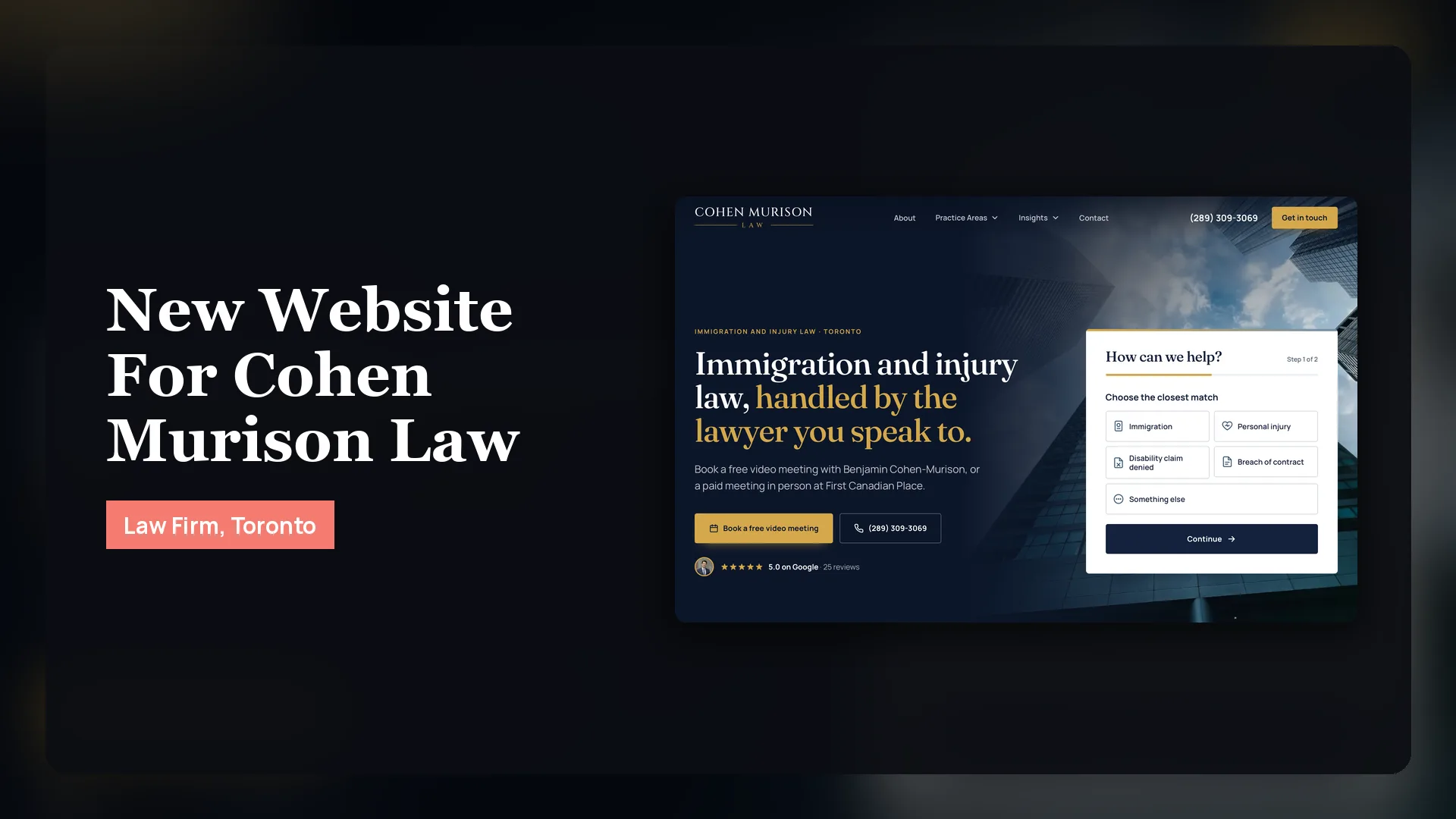
Cohen Murison Law: A New Website For A Toronto Immigration And Injury Lawyer
Toronto law practice for immigration, personal injury and disability claims.

KSK’s Surge: 35K Monthly Clicks With Authority-Driven SEO
National corporate law firm serving Fortune 500 clients in India.

From Zero to Visibility in UAE’s Legal Market For ABS Partners
Boutique corporate and commercial law firm based in the UAE.

IndiaLaw’s 39000 clicks a month With Zero Paid Ads: A Legal SEO Masterclass
Pan-India full-service litigation and dispute resolution firm.
Konan & Spade revolutionized our digital presence. Their expertise in law firm marketing is unmatched, the website, SEO, everything they deliver is top-tier.