Service
The Law Firm GEO Agency That Starts Where AI Actually Looks
When a client asks an AI which lawyer to instruct, the answer is assembled from independent sources you mostly do not control. We work those sources, in the order that decides the answer.
Book a strategy callWhy Generative Engine Optimization Works Differently for Law Firms
Search has stopped being a list of links. By early 2026, around 68% of all searches ended without a click, and once an AI answered, the figure passed 83%. The answer became the destination. For law firms the mechanics are unusual: a cautious engine will not take your word for whether you are any good, so it reaches for independent sources instead, and it can only reach for the ones it can read. Research published in 2026 found that seven directories dominate the AI citations for legal queries. Your website still matters. It is the floor everything else stands on, not the ceiling.
-

The answer is now the destination
Around 68% of searches end without a click, rising past 83% once an AI answers. You never see the client an engine declined to mention, which is what makes this decline so hard to arrest.
-

Seven directories own the legal citations
Chambers, The Legal 500, Avvo, Justia, Super Lawyers, Best Lawyers and Martindale carry the bulk of AI citations for legal queries. Not because they are grandest, but because they are independent and readable.
-

Your own website is trust-capped
Praise you write about yourself is worth roughly what it costs to write. Owned content is foundational and genuinely decisive in the niches, but it rarely wins an answer on its own.
-

Citation share replaces rankings
The question is no longer where you rank. It is how often the engine says your name when a client asks the questions that bring you leads.
Why Most GEO Falls Short for Law Firms
Most GEO packages were written for businesses that can say almost anything about themselves. You cannot, and the engines know it. A generalist agency will sell a law firm the same optimisation package it sells a furniture brand, on the quiet assumption that an algorithm cannot tell the difference between selling a sofa and choosing a litigator. It can, and that is rather the whole point.
- Problem
Schema and technical markup sold as the strategy
How we fix itWe treat the plumbing as hygiene, not the lever. Done once, properly, then we spend the rest where citations are actually decided.
- Problem
No directory ranking in the practice areas that need one
How we fix itWe run directory submissions as a discipline, gathering evidence all year rather than scrambling the week before a deadline.
- Problem
Budget spent on gated prestige the engines cannot read
How we fix itIf you cannot read it without logging in, neither can the AI. We move the marginal spend to sources that are genuinely readable.
- Problem
A scattered entity, with details disagreeing across profiles
How we fix itWe make you one entity, several times confirmed: identical details everywhere, Google Business Profile completed, Wikidata built.
- Problem
Paid awards and syndication mistaken for authority
How we fix itReach is not citability. We pursue the earned, not the bought, because the bought is exactly what the machines discount.
- Problem
Success still measured in rankings and traffic
How we fix itWe track citation share: whether you were named, what was cited, and whether it was accurate.
Why Choose Us As Your Law Firm GEO Agency
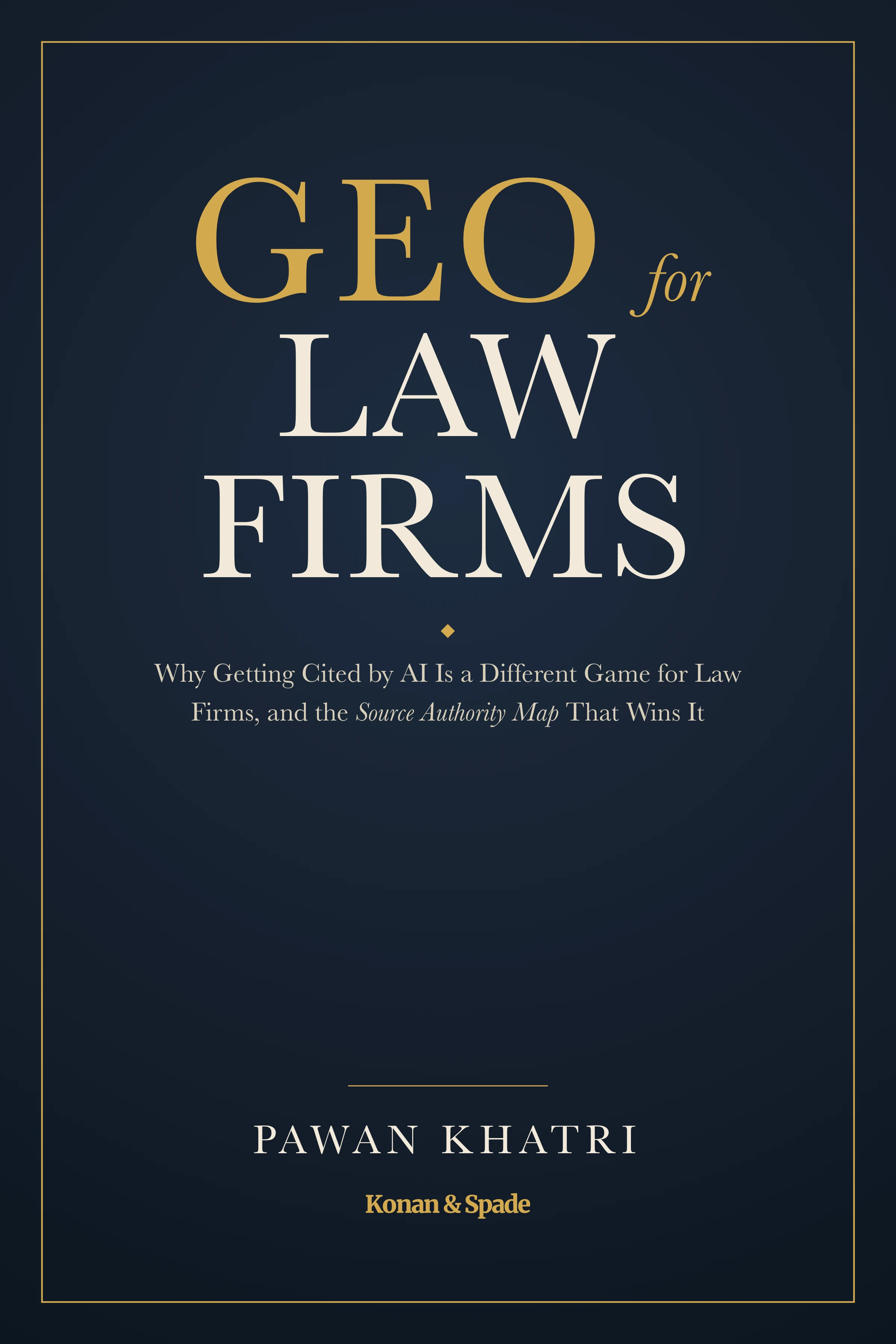
We work from a published framework rather than habits borrowed from selling software. The Law Firm GEO Authority Map™ (Konan & Spade Framework) scores every source that decides whether an engine cites your firm, re-weighted by what the machine can actually read. It was written by a lawyer who chose marketing, which mostly means we will tell you when the answer is that you do not need us.
-

Built on the Law Firm GEO Authority Map™
-

Directory submissions run as a yearly discipline
-

Measured monthly in citation share
-

Strategy decided per practice area, not per firm
How We Execute GEO for Law Firms
The order matters more than the effort. We do the heavy, slow things first and take the cheap wins alongside them, rather than starting with whatever is easiest to invoice.
-
 See Clearly: the GEO Authority Audit
 We score your presence against every source that decides a legal answer, and baseline how often the engines name you today.
- Every source scored absent, weak, or strong, and weighted by tier
- Baseline citation share across ChatGPT, Gemini, Perplexity and Google's AI answer
- The output is not a grade, it is a ranked list of named jobs
-
 Decide the Mode, Practice Area by Practice Area
 An AI names firms in one of two ways, and which one applies decides where every dirham of effort goes.
- List-Led: a directory ranks the area, so the ranking is close to the answer itself
- SERP-Led: no credible list exists, so your content can win outright and quickly
- Decided per keyword, never per firm, because most firms are honestly both
-
 Win the Lists, and Fix the Entity
 The slow giant and the cheap wins run in parallel, because one pays in months and the other pays immediately.
- Directory submissions prepared all year, across the practice areas that need them
- Identical name and details everywhere, Google Business Profile completed, Wikidata corrected
- A check that your site is not quietly blocking the AI crawlers, which undoes everything else
-
 Earn the Open Layer, and Measure Monthly
 In the niches no directory ranks, your content moves from corroboration to the main event. Then we watch what the engines actually say.
- Claims a machine can lift: specific, attributed, and jurisdiction-specific
- Genuine coverage in outlets that did not invoice you
- Twenty or thirty real client questions, put to the engines every month
Frequently asked questions
Will a better website get my firm into AI answers?
Rarely on its own. Praise you write about yourself is trust-capped, so a cautious engine reaches for independent sources instead. Your site is the floor everything else stands on. In practice areas no directory ranks, it can win outright, which is exactly why we mark every practice area before spending anything on it.
Is schema markup the lever?
No. It is hygiene. Schema does not change your evidence, it makes your evidence legible, and it manufactures neither a directory ranking nor an organic position you have not earned. We do it once, properly, and then stop. Anyone selling it to you as the strategy is mistaking the plumbing for the house.
Which sources actually decide a legal AI answer?
Research published in 2026 found seven directories dominate AI citations for legal queries: Chambers, The Legal 500, Super Lawyers, Best Lawyers, Martindale-Hubbell, Avvo and Justia. Independence and readability are the reason. A source you can only read after logging in is a source the AI cannot read either.
Does this work for a Dubai or wider GCC practice?
Yes, with a regional adjustment. The GCC has thin local directories, so Chambers Global and Middle East, The Legal 500 EMEA, and the open regional legal press carry more weight here than they would in North America. DIFC and ADGM disputes and mainstream corporate work are usually List-Led. Narrower cross-border GCC niches often have no credible list at all, which makes them winnable on content alone.
Is GEO relevant only for large firms?
No. Much of what decides an answer costs nothing but attention: a completed Google Business Profile, profiles that agree with each other, a Wikidata entry. Most firms have these sitting at zero, which makes them available upside rather than a budget line.
How do you measure it?
Citation share: how often the engines name you when clients ask the questions that bring you leads. We take twenty or thirty real client questions, put them to the engines monthly, Perplexity first because it shows its sources, and record three things: whether you were named, what was cited, and whether what was said about you was accurate. A citation that misdescribes you is a problem wearing the costume of a win.
Should we buy an AI visibility dashboard?
Not first. Do it by hand until you understand what you are looking at, because a tool that produces a number you do not understand is worse than a spreadsheet you do. When the manual work outgrows the hour it should take, a tool earns its place. The platforms have started reporting some of this themselves, but the rollouts are partial and the definitions still shifting, so treat them as a supplement to your own testing.
What about Mondaq, Lexology and JD Supra?
Treat them as optional distribution, never the strategy. They are largely registration-gated, they duplicate content already sitting on your own site, and anyone who pays can appear, which strips out the independence that makes a source worth citing. Publishing a client alert there feels like joining the open layer. It is closer to filing it in a drawer.
Will GEO damage our existing SEO?
No. Ordinary search optimisation still decides the practice areas where no directory ranks, and on Google's AI answer it still carries real weight, though the link between ranking and citation has loosened noticeably through 2026. What changes is where the marginal budget goes, and the honest answer is that it goes to the directories first.
How long does this take?
Ninety days moves a firm from invisible to present, which is where compounding begins. It does not finish the work. The directory cycle is annual and unforgiving, and some of this compounds over years. Anyone promising market dominance in a quarter is selling you a timeline, not a result.
GEO For Law Firms Guide
AI-generated answers are changing how clients find legal help. As platforms like Google AI Overviews, Bing Copilot, ChatGPT, and Perplexity reshape search behavior, firms relying only on traditional SEO risk being excluded. This guide introduces Generative Engine Optimization (GEO) as a necessary shift. GEO gets your law firm’s content cited by AI as the trusted legal source. We break down the actions required to build lasting visibility, credibility, and relevance across emerging AI platforms now dominating search results.
- 01
Understanding Generative AI and Its Legal Impact on Legal Marketing
Generative AI uses large language models to generate answers instead of listing links. These models reference sites with structured, citation-backed, and well-written content. In legal marketing, this means your website must align with what AI looks for when summarizing legal topics. Visibility today is about being the source these models trust and surface, not just ranking in search. Law firms must adapt how content is written and structured to match this shift or risk being left out of AI-generated summaries altogether.
- 02
How AI-Driven Engines Are Reshaping Legal Search
AI-powered search now delivers direct answers. Google AI Overviews summarize legal queries above traditional results. Bing Copilot, ChatGPT Browsing, and Perplexity do the same. Users no longer scan multiple websites, they rely on platforms to summarize information. Only content that is structured, relevant, and reliable gets cited. These systems promote authoritative sources and omit others entirely. If your firm’s content isn’t machine-readable, legally accurate, and clearly organized, you’re invisible. GEO ensures your firm becomes part of the response, not just another unclicked link.
- 03
What GEO Means for Law Firms
GEO focuses on aligning legal content with how AI systems extract, synthesize, and present information. Unlike SEO, which prioritizes links and rankings, GEO prioritizes structure, clarity, and source trustworthiness. It means reworking headings, schema, and internal links so AI platforms can interpret your expertise confidently. The goal is to be referenced in AI-generated responses across Google, Bing, and legal assistants, not merely appear in blue links. Law firms using GEO gain more than traffic, they gain trust, visibility, and long-term lead flow from high-intent users.
- 04
Building AI-Optimized Legal Content
GEO content must be skimmable, precise, and easy for AI to understand. Long paragraphs and vague claims are ignored. We rewrite content using short paragraphs, bulleted points, clear headings, and schema-backed structure. FAQs, internal links, and summary sections help machines understand legal nuances. Multimedia like infographics or visual summaries improves AI comprehension. Every page must serve a direct purpose and answer user queries clearly. Content built this way earns visibility and becomes eligible for citation in AI-generated legal answers.
- 05
Thematic Search and Content Mapping
AI search works through themes, not just keywords. A query like “divorce in California” may surface cost, timeline, and process-related sub-questions. To appear across these themes, your firm must publish content clusters covering the full scope of user concerns. We structure content so related topics, like custody, asset division, or local laws, are interconnected. This builds semantic relevance. Without this depth and interlinking, your site may be skipped even if the content is accurate. GEO aligns your site with how users explore legal topics through AI.
- 06
Schema Markup and Structured Legal Data
AI systems rely on schema to identify what your site represents. Without structured data, your legal services are invisible to machines. We implement schemas like LegalService, Attorney, Organization, FAQPage, and BreadcrumbList across all content. This improves visibility in AI results, voice search, and smart assistants. Schema also boosts credibility, AI platforms prefer content they can validate. Each change is tested for compliance using Google’s tools to ensure accuracy. Updating schema is not optional anymore; it’s foundational for inclusion in generative legal search.
- 07
Establishing Topical Authority With Semantic SEO
Authority in AI search depends on depth and content structure. Isolated practice pages no longer perform. We build practice area hubs supported by satellite pages targeting related legal subtopics. For example, “Divorce Lawyer” connects to pages on alimony, custody, and asset division. Internal links reinforce the structure. Semantic consistency tells AI systems your firm has depth of expertise. This approach makes your site more likely to appear when users engage in long-form legal queries within ChatGPT, Bing, or AI Mode on Google.
- 08
Real-Time Testing and Content Iteration
GEO is not guesswork, it’s testable. We simulate legal searches inside Google SGE, Bing Copilot, and ChatGPT with Browsing to see if your content gets surfaced. When it doesn’t, we revise and restructure until it does. Testing includes branded and long-tail prompts that reflect real user behavior. AI visibility fluctuates, so monthly audits are essential. These tests show how models interpret your site, helping us refine what works. Ongoing iteration keeps your firm present in evolving AI systems, even as algorithms change.
- 09
The Role of Evidence, Citations, and Clarity
AI favors content it can trust. For law firms, that means adding citations, legal references, quotes, and links to verifiable sources like bar associations. Generic legal advice or ambiguous language won’t be cited. We write clearly, using legal definitions, step-by-step breakdowns, and jurisdictional markers. This gives AI systems confidence in summarizing your content. It also builds user trust, clients want clarity. Verified, structured, and evidence-backed content makes your firm eligible for inclusion in high-visibility AI answers across multiple platforms.
- 10
Multimedia and Multimodal Indexing
AI systems now parse images, video, and audio. Legal content should expand beyond text. We help you add video explainers, audio summaries, or infographics to legal pages. These elements are optimized with schema, captions, and alt text to ensure discoverability. Platforms like YouTube and ChatGPT now highlight visual content in responses. When your firm appears in video-based results, it enhances engagement and recall. Multimodal content improves reach across formats, and AI now rewards this variety with stronger inclusion rates.
- 11
Updating Legal Content for AI Inclusion
AI platforms prioritize content that’s current and accurate. Outdated legal pages, even if well written, may be excluded from generative answers. We implement a routine update cycle to refresh service pages, FAQs, and legal explainers. Updates reflect legal changes, jurisdictional shifts, and user expectations. Fresh content increases model confidence and improves visibility. GEO depends on timely, structured information. We ensure nothing is stale or misaligned. Staying visible in AI results requires more than publishing once, it requires proactive maintenance and revalidation.
- 12
Final Thoughts
GEO is not a rebrand of SEO, it’s a separate, urgent discipline. Law firms that invest in structure, clarity, testing, and topical coverage now will lead search visibility tomorrow. Generative engines are shaping how users discover and evaluate legal help. Being referenced by these systems means higher trust and higher-converting leads. The firms that adapt early will compound authority across platforms, while others fall behind. GEO is how your law firm stays seen, cited, and relevant in AI-first legal search.
Case studies

The shift to Generative Engine Optimisation made an immediate difference. Our firm appeared in AI-generated summaries for our core practice areas, bringing in leads we previously missed.