GEO for Law Firms: How AI Decides Which Firm to Name
Law firm GEO is not won on your website. It is won across the independent sources AI can actually read. The two modes, the Authority Map, and a 90-day order

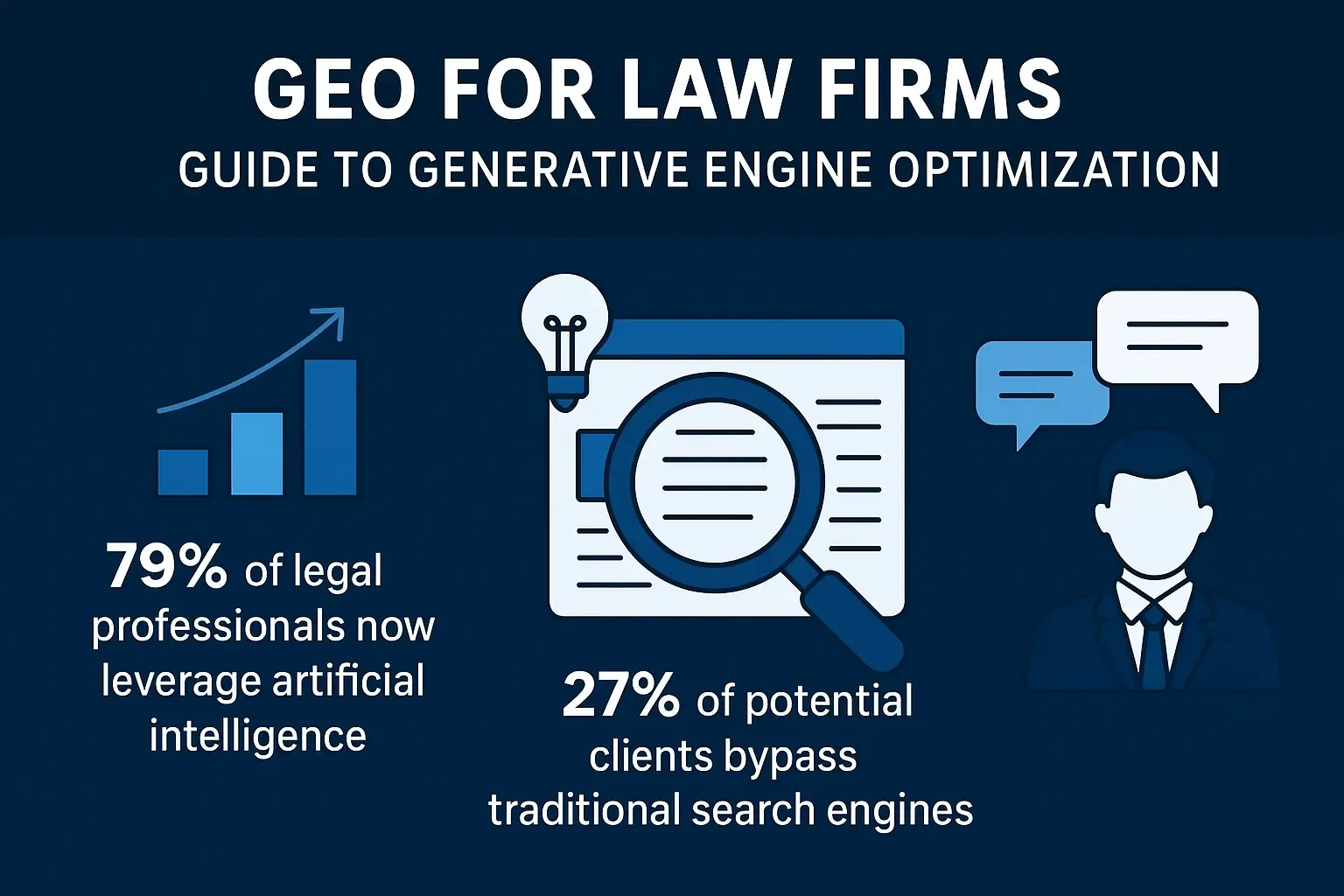
Ask ChatGPT, Gemini, or Perplexity which firm should handle a shareholder dispute in the DIFC, and you will get three or four names. Not a list of ten blue links to work through. Names, with reasons attached. Your prospective client reads that answer and acts on it, and if your firm is not in it, you will never know the instruction existed.
That is the whole problem, and most Generative Engine Optimization (GEO) advice will not solve it for a law firm. The generic version of this discipline assumes the contest is won on your own website: tidy your pages, add structured data, publish more, and the machine will notice. For a software company selling a subscription, that is broadly true. For a law firm it is mostly false, and the reason is worth understanding before you spend anything.
The answer became the destination
By early 2026, around 68% of all searches ended without a click to any website. When the search triggered an AI answer, the figure passed 83%, and on Google’s AI Mode it reached roughly 93%. People read the answer and stop.
Legal queries are squarely inside this shift. Research published in 2026 found that 23.6% of legal queries now trigger an AI Overview, rising to 57.9% for question-style legal queries, which is exactly how a worried client phrases things at eleven at night.
The danger here is quieter than the one usually sold to you. Engines do not typically invent firms or send your clients to a rival by malfunction. You simply stop appearing, while your rankings report stays green and your traffic chart looks healthy. There is no bounce rate for a recommendation you never received.
An AI chooses whom to name in one of two ways
This is the distinction that governs everything else, and almost nobody selling GEO makes it.
Mode one, List-Led. An authoritative ranking already exists for the practice area, so the engine defers to it. If you are not ranked, you are not in the answer, however good your website is. In our own testing across several hundred queries, a firm absent from both Chambers and The Legal 500 appeared in fewer than one answer in ten, however high it ranked on Google. One client sat at the very top of the ordinary results for banking and finance in the UAE and went unnamed by every engine, for one reason: it held no directory ranking in that practice area.
Mode two, SERP-Led. No credible list exists for the niche, so the engine assembles its answer from ordinary search results, and classic search optimisation wins. This is where your own content stops corroborating and becomes the main event.
The mistake almost everyone makes, including people who should know better, is asking “is my firm a directory firm or an SEO firm?” It is the wrong question. The honest answer for nearly every firm is “both, depending on the work.” Strategy is decided per practice area, not per firm. Your arbitration practice and your fintech advisory may sit in different modes, and spending the same budget on both is how firms waste money confidently.
What actually decides a legal AI answer
A cautious engine will not take your word for whether you are any good. Praise you write about yourself is worth roughly what it costs to write. So it reaches for sources that are independent of you, and it can only reach for the ones it can read.
Those two conditions, independence and readability, produce a result that surprises most partners. Research published in 2026 found that seven directories dominate AI citations for legal queries: Chambers, The Legal 500, Super Lawyers, Best Lawyers, Martindale-Hubbell, Avvo, and Justia. Not because they are the most prestigious sources in legal, but because they are independent and a machine can read them. The same research found 79% of lawyers now use AI internally, which is a pleasant irony: the profession has adopted the technology enthusiastically while remaining largely invisible to it.
Directories also survive contact with how clients actually behave. A Legal 500 survey of 2,536 General Counsel found 69% consult a directory before instructing. The machine and the GC are reading the same page.
The inversion: prestige and readability are not the same thing
Here is where legal marketing budgets go wrong at scale. Every source can be scored two ways.
Its evaluation-weight answers: how much does this tell me about how good the firm is? Its GEO-weight answers a different question entirely: how likely is it that an AI will read this before it answers a client?
Assuming those two numbers are the same is the single most expensive error in legal marketing today. Firms spend against prestige and proof, then wonder why the machine has never heard of them. They are paying to be good in a way the AI cannot see.
Consider what this does to the usual spending priorities. Mergermarket, Bloomberg Law, LSEG, the gated brand-perception surveys, the subscription league tables: these sit behind paywalls the machines cannot pass. Their contribution to whether an engine names you is not “some, indirectly.” It is nothing, or close enough to nothing that you should plan as if it were zero. The most expensive intelligence in legal is, for the purpose of being recommended, an elaborate way of talking to nobody.
Meanwhile your Google Business Profile, your Wikidata entry, and your profiles on the open directories cost almost nothing and are sitting at zero for most firms. That is not a criticism. It is available upside.
Five questions that tell you whether a source counts
You can run all of these yourself, today, with nothing but a browser.
- Open? Can you read it without logging in? If you cannot, neither can the AI. This one is a gate, not a weight: fail it and the source is invisible regardless of prestige. It is the single most important rule here, and the one to repeat to anyone selling you a gated platform as “AI visibility”.
- Trusted? Is it independent, or did you pay to appear? If a firm could get on the list by writing a cheque or sending a press release, the list is worthless, and so is a place on it.
- Retrieved? Do the engines actually cite it? Ask Perplexity your real client questions and watch which sources it keeps pulling. It shows its work, which makes it a free readout of what gets retrieved.
- Quotable? Can a machine lift one sentence that says, unambiguously, who is good at what? A page murmuring about “a partner-led approach and a commitment to excellence” fails, because there is nothing in it a machine can quote without embarrassing itself.
- Fresh? Does it have a pulse, or a death certificate? The directories refresh annually. The open legal press refreshes daily. Your own content refreshes whenever you choose to feed it.
What this means for a Dubai or wider GCC practice
The GCC has thin regional directories, which changes the weighting rather than the method. The global directories carry more weight here than they might elsewhere: Chambers Global and Chambers Middle East, and The Legal 500 EMEA. The open regional legal press does real work, including Al Tamimi’s Law Update, The Oath, and Zawya, precisely because it is readable. Lexis Middle East, by contrast, sits behind a subscription, which makes it excellent for research and invisible for citation.
Practice area matters more than firm size. DIFC and ADGM disputes and mainstream corporate work are usually List-Led, so the ranking is the job. Narrower cross-border GCC niches often have no credible list at all, which means they are winnable on content alone, and quickly. Mark each one before you spend on it.
Schema markup is plumbing, not a lever
Let me set this expectation honestly, because the people who sell this work rarely will.
Structured data, llms.txt, markdown mirrors, WebMCP: all of it is hygiene. Schema is the difference between handing the court a properly paginated, indexed bundle and handing it a box of loose papers. It does not change the facts. It makes the facts legible. It manufactures neither a directory ranking nor an organic position you have not earned.
So do it, once, properly, and then stop. If you do one technical thing well, make it sameAs, the label whose entire job is to tell a machine that your listings all refer to the same firm. And check today that your website is not quietly blocking the AI crawlers, because that single misconfiguration undoes everything else here.
Nobody admires a building for its pipes. Anyone presenting the pipes as the strategy is, generously, mistaking the plumbing for the house.
Your entity is the substrate
A machine does not reason about firms. It reasons about entities. Two firms with identical rankings fare differently because one has resolved into a clean, well-connected entity and the other exists as a scatter of slightly inconsistent mentions. An uncertain machine, in a field as high-stakes as law, reaches for someone it is surer about.
The fix is unglamorous and mostly free. Identical name, address, and contact details everywhere you appear, not similar ones. Google Business Profile claimed and completed, with a steady flow of genuine reviews. Wikidata created or corrected. Profiles that agree with your website, because a profile that contradicts it is worse than no profile at all.
The firm that is in Chambers, in Avvo, in its Google listing, and in Wikidata, all agreeing, is not four times listed. It is one entity, four times confirmed, and confirmation is what turns a cautious machine into a confident one.
What to measure
Rankings and traffic now tell a dishonest story. A firm can be slipping out of the answers that decide instructions while its dashboards stay green. The instruments are reading the wrong dial.
The metric that replaced ranking is citation share: when clients ask the questions that bring you leads, how often are you named, compared with your competitors? Track three things, monthly. Were you named. What was cited. Was what the engine said about you accurate, because a citation that misdescribes you is a problem wearing the costume of a win.
Twenty or thirty real client questions is plenty. Put them to the engines once a month, Perplexity first because it shows its sources, then ChatGPT, Gemini, and Google’s AI answer. An hour, done regularly, turns vague anxiety into a trended picture.
Do not buy a dashboard yet. Do it by hand until you understand what you are looking at, because a tool that produces a number you do not understand is worse than a spreadsheet you do.
One honest caveat, since this field is full of people selling certainty they have not earned: citation share tells you whether the machines name you. It does not directly tell you whether that became signed clients. Attribution here is genuinely hard, because a client who acted on an AI recommendation often arrives with no trackable click. Two questions at intake do more than any analytics build: “How did you first come across us?” and, if the answer is vague, “Did an AI assistant come into it at any point?”
The order of work
The order matters more than the effort. Do the heavy, slow things first, and take the cheap wins alongside them, rather than starting with whatever is easiest.
Weeks one and two: see clearly. Score your presence on every source that decides your answers. Take a baseline citation share. Mark every practice area List-Led or SERP-Led. The output is not a grade, it is a ranked list of jobs, because every zero on an important source is a specific, named task.
Weeks two to six: cheap wins and the slow giant, in parallel. The quick ones are the entity essentials above, plus checking your robots file. The slow one is the directory submissions, and they start now rather than when the deadline looms, because the cycle is annual and unforgiving. In your important List-Led practice areas, the correct number of cycles to skip is zero. The mechanics of that submission, and they are genuinely mechanical, are set out step by step in our practical guide to Chambers and Legal 500 submissions. The firm that logs notable matters as they close, rather than scrambling at deadline, submits from a position the last-minute firm can never match.
Weeks six to twelve: the open layer and the habit. Publish real depth in your SERP-Led niches, where you can win outright. Make partners genuinely reachable to journalists, and earn mentions from outlets that did not invoice you. Set the monthly measurement habit, which is what turns a ninety-day push into a permanent capability.
Ninety days will not finish this. Some of it compounds over years. But ninety days spent in this order moves a firm from invisible to present, and present is where compounding begins. Anyone promising market dominance in a quarter is selling you a timeline, not a result.
A note on the tool we built
One practical note, and then I will stop. Directory submissions are the part of this that most often defeats a busy team, not because they are difficult but because they are relentless: evidence gathered all year, referees chased, deadlines that move for nobody.
We built Folio at Konan & Spade to automate that specific, recurring work, alongside the pipeline and relationship tracking that sits around it. Use it or do not. The point that matters is the discipline, not the software.
The book this method comes from
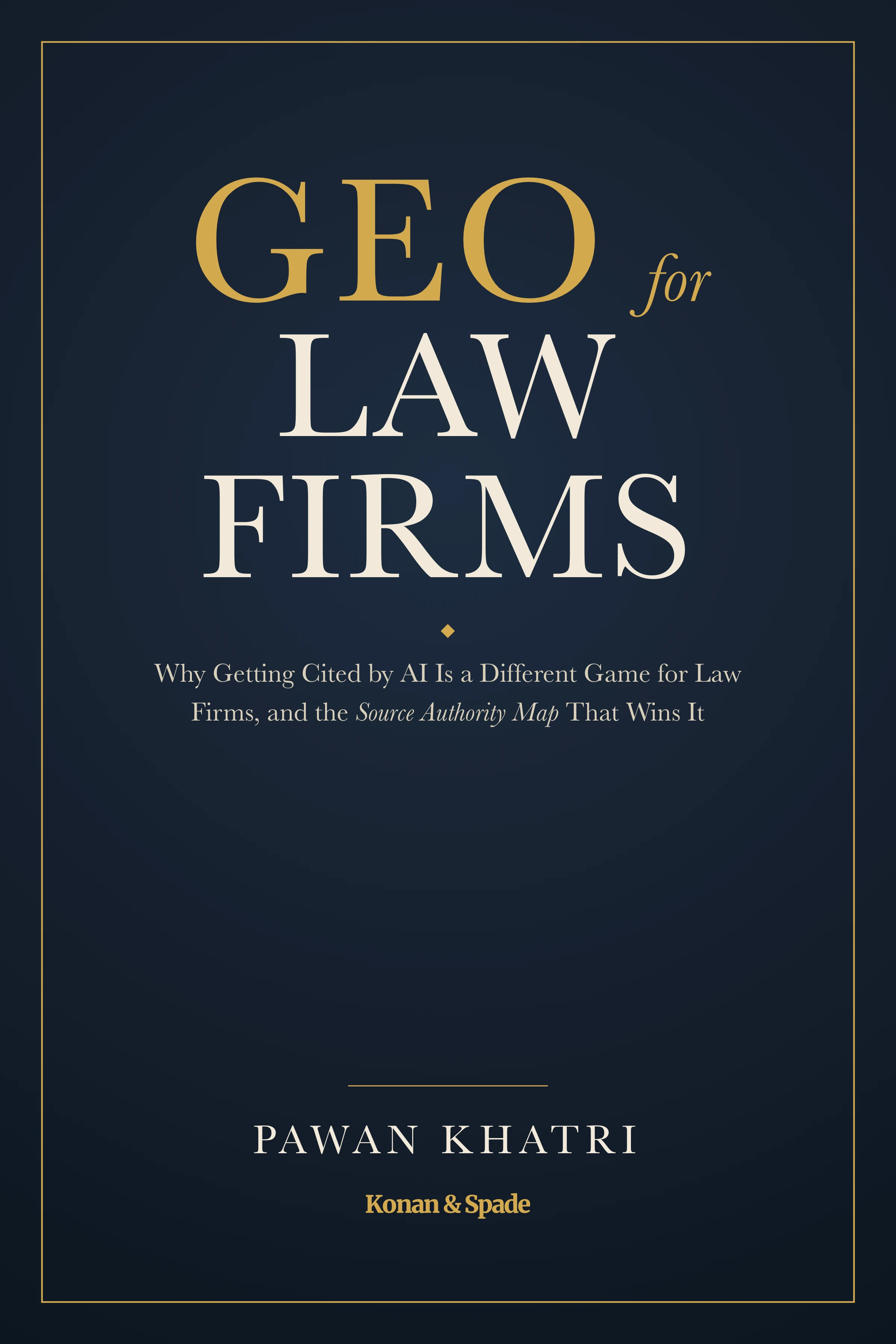
GEO for Law Firms, by our founder Pawan Khatri, is the first book to treat law firm GEO as its own discipline. Everything above is drawn from it: the two modes, the inversion, the five tests, and the ninety-day order of work.
It is built around the Law Firm GEO Authority Map™ (Konan & Spade Framework), an eight-category model of every source that decides whether an AI cites your firm, re-weighted by what the machine can actually read. Paperback, 150 pages. ISBN 978-8168917828. Published 12 July 2026.
Read it first and decide whether you need us at all. We would rather be argued with than taken on faith.
Where to start
Generic GEO is won on your own website. Law firm GEO is won across an authority ecosystem you mostly do not control, re-weighted by what AI can actually read. Readability beats prestige, the earned beats the bought, and the firm that gets named is not always the grandest. It is the one a machine can read, trust, and quote.
If you want the method in full, the book is the honest answer. If the directory submissions are the part that has outgrown your team, which is usually the part that does, that is the specific work we run. Our approach to GEO for law firms follows the same order set out above, because there is not a second, better order we keep for paying clients.
Sources
Every figure above resolves to one of these. Where a claim is our own testing rather than published research, it is marked as such in the text.
- Zero-click search, 2026: Search Engine Land, with SparkToro and Similarweb
- Seven directories, legal AI citations, 79% of lawyers using AI internally, 23.6% and 57.9% legal AI Overview triggers: 5W and Haute Lawyer, Legal AI Visibility Report 2026
- 69% of General Counsel consult a directory before instructing, survey of 2,536 GCs: The Legal 500 GC survey via National Law Review
- Chambers ranking methodology and independence: chambers.com
- The Legal 500 rankings and editorial independence: legal500.com
- The two modes, and the fewer-than-one-in-ten finding for firms absent from the directories: Konan & Spade internal testing across several hundred queries
Subscribe for Legal Marketing Insights
Stay ahead with proven strategies, case studies and AI-driven tactics.
Frequently Asked Questions
Is law firm GEO different from ordinary GEO?
Yes, and the difference is the whole point. Generic GEO is won on your own website. Law firm GEO is won across an authority ecosystem you mostly do not control, because a cautious engine will not take your word for whether you are any good. It reaches for independent sources instead, and it can only reach for the ones it can read.
Which sources decide whether an AI names my firm?
Research published in 2026 found seven directories dominate AI citations for legal queries: Chambers, The Legal 500, Super Lawyers, Best Lawyers, Martindale-Hubbell, Avvo and Justia. Independence and readability are the reason, not prestige. A source you can only read after logging in is a source the AI cannot read either.
Does schema markup get my firm into AI answers?
No. Schema is hygiene. It does not change your evidence, it makes your evidence legible, and it manufactures neither a directory ranking nor an organic position you have not earned. Do it once, properly, then stop. If you do one technical thing well, make it sameAs.
How should a Dubai or GCC firm approach this?
The GCC has thin regional directories, so Chambers Global and Middle East, The Legal 500 EMEA, and the open regional legal press carry more weight here than elsewhere. DIFC and ADGM disputes and mainstream corporate work are usually List-Led. Narrower cross-border niches often have no credible list, which makes them winnable on content alone.
How do I measure AI visibility?
Citation share: how often the engines name you when clients ask the questions that bring you leads. Take twenty or thirty real client questions, put them to the engines monthly, Perplexity first because it shows its sources, and record whether you were named, what was cited, and whether it was accurate. Do it by hand before buying any tool.
Case studies

KSK’s Surge: 35K Monthly Clicks With Authority-Driven SEO
National corporate law firm serving Fortune 500 clients in India.

From Zero to Visibility in UAE’s Legal Market For ABS Partners
Boutique corporate and commercial law firm based in the UAE.

IndiaLaw’s 39000 clicks a month With Zero Paid Ads: A Legal SEO Masterclass
Pan-India full-service litigation and dispute resolution firm.
From Family Law Practice to Premium Brand: Atharkhan.com Redesign
Law Office of Athar A. Khan
Konan & Spade revolutionized our digital presence. Their expertise in law firm marketing is unmatched, the website, SEO, everything they deliver is top-tier.